
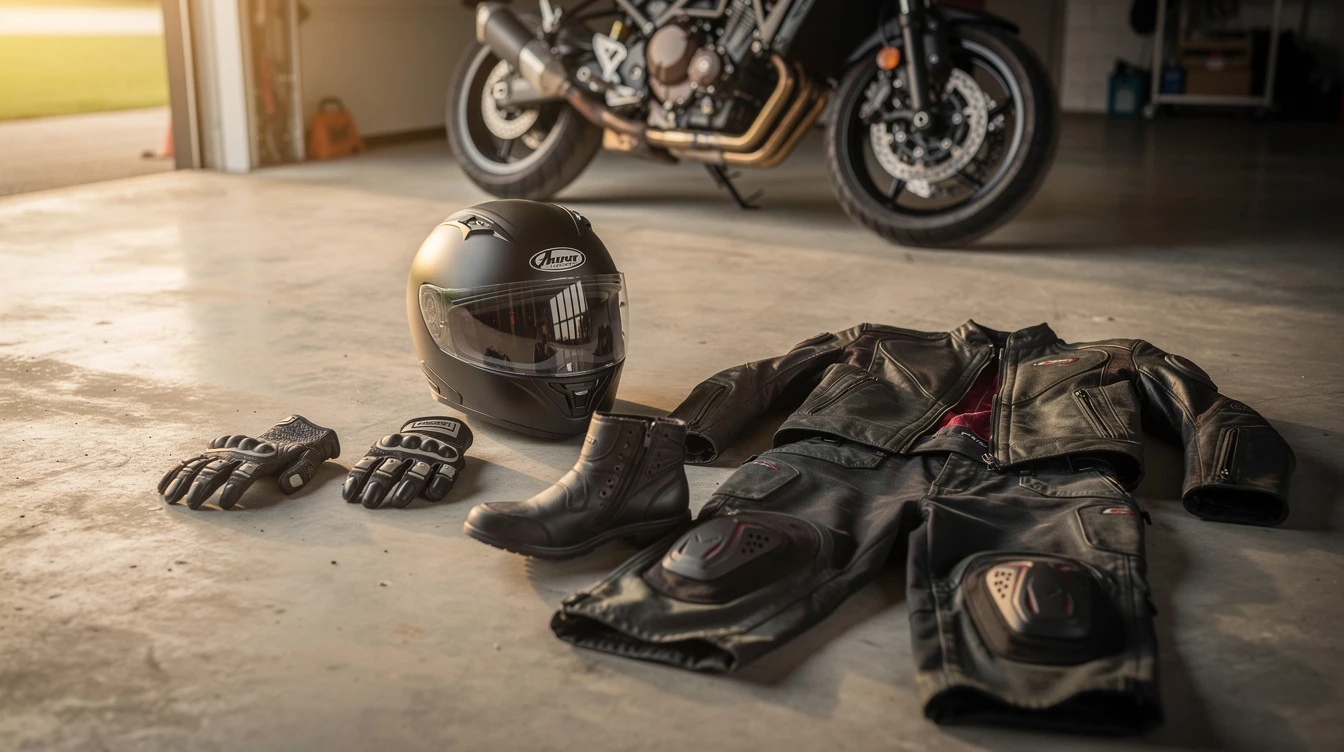
What motorcycle safety gear do you consider essential for every ride? The short answer: a helmet, jacket, gloves, pants, and boots, every single time. But the longer answer matters far more, because the gap between basic awareness and real protection is where riders get hurt.
This guide breaks down each piece of gear, explains what it actually protects against, and gives you the numbers to back up why skipping even one item is a serious gamble. Whether you're commuting daily, taking weekend canyon runs, or just completed your first MSF Basic Rider Course, this is the gear breakdown you need before your next ride.
Gear questions don't exist in a vacuum. Rider skill, defensive habits, and training all work together with your equipment. But gear is the last line of defense when everything else fails.
A Helmet Is the Single Most Critical Piece of Motorcycle Safety Gear
Helmets reduce the risk of fatal head injury by approximately 37% and reduce the risk of head injury overall by about 69%, according to data from the National Highway Traffic Safety Administration. Those aren't soft estimates. They're drawn from decades of crash analysis across tens of thousands of incidents.
Full-face helmets offer the broadest protection, covering the chin and face, which absorb impact in roughly 35% of crashes. Open-face and half helmets leave those areas exposed. Modular helmets sit in between, offering a flip-up chin bar for convenience, though they're typically tested to a slightly lower standard than fixed full-face designs.
What Helmet Certifications Actually Mean
DOT certification (required in most U.S. states) sets a minimum impact standard. ECE 22.06, the European standard adopted in 2020, is widely considered more rigorous. SNELL certification, updated every five years, is the strictest widely available standard. Look for at least DOT on any helmet you ride in, and consider ECE or SNELL if budget allows.
How Often to Replace Your Helmet
Most manufacturers recommend replacing a helmet every five years, even without a visible impact. The EPS foam liner degrades over time from sweat, UV exposure, and minor vibrations. After any significant impact, replace it immediately, even if it looks fine externally.
Protective Jackets Reduce Abrasion Injury by a Measurable Margin
Road rash accounts for a significant share of non-fatal motorcycle injuries, and a quality jacket is the primary defense. Leather jackets at 1.2, 1.4mm thickness can withstand abrasion for about 4 seconds at 60 mph before failing. Textile jackets with ballistic nylon or Cordura construction offer similar or better performance depending on denier rating, and they handle weather more practically for daily commuters.
Ready to register your vehicle?
Join thousands of vehicle owners who use Montana Motorcycle Safety Foundation to handle their registration quickly.
Get started today. →CE Level 1 armor at shoulders and elbows is the baseline. CE Level 2 armor absorbs significantly more impact energy and is worth the upgrade at any price point. Back protectors deserve special attention: CE Level 1 back armor is standard in most jackets, but inserting a standalone CE Level 2 back protector costs $30, $80 and covers spinal impact that jackets alone often underserve.
Jacket Fit and Its Role in Protection
Armor only works when it stays in place during a crash. A jacket that rides up, twists, or gaps at the waist defeats the purpose of the armor inside it. Look for connection loops that attach to riding pants, snug cuff closures, and armor pockets that hold their position even when you raise your arms. Fit matters as much as material.
What Motorcycle Safety Gear Provides the Best Protection for Daily Commuting?
For daily commuters, a textile jacket with CE Level 2 armor, a full-face helmet, and weatherproof gloves offer the most practical combination. Textile gear handles temperature swings better than leather and dries faster. Many commuter jackets also include hi-vis panels or reflective piping, which meaningfully improves visibility during low-light conditions, a factor in a disproportionate share of urban motorcycle incidents.
Gloves and Boots Protect the Body Parts Riders Instinctively Use in a Fall
Human instinct in a fall is to reach out with both hands. Without gloves, the palms and fingers absorb full road contact. Motorcycle gloves with palm sliders, knuckle armor, and wrist closure can dramatically reduce abrasion and fracture risk in that first point of impact. Gauntlet-style gloves that extend past the wrist offer additional protection for the forearm and wrist joint.
Feet and ankles are equally vulnerable. Standard sneakers offer zero lateral support and almost no abrasion resistance. Motorcycle-specific boots are engineered with ankle protection, toe reinforcement, and soles that grip footpegs rather than sliding off. Over-the-ankle height is the minimum standard. Tall moto boots that cover the lower shin are ideal for higher-speed riding.
Glove Features Worth Paying For
Look for stitched seams on the outside of the palm (so seams don't grind into skin during a slide), a wrist strap or closure that keeps the glove on during impact, and touch-screen-compatible fingertips if you use a phone mount. Budget gloves start around $40; quality CE-rated gloves with proper palm sliders run $80, $200.
Boot Selection by Ride Type
Sport riders generally prefer short racing boots with rigid ankle cups. Touring and adventure riders favor taller boots with waterproofing and walk-ability. Urban commuters often opt for café-style moto boots that pass as street footwear. All three types can meet basic protection standards, so pick the one you'll actually wear every time.
Riding Pants Complete the Gear System Most Riders Skip
Riding pants are the most commonly skipped piece of motorcycle safety gear, particularly in warm weather. That's a serious gap. The hips, knees, and thighs represent major impact and abrasion zones in a lowside crash, and standard denim jeans fail within fractions of a second at highway speeds.
Motorcycle-specific pants, whether leather, textile, or kevlar-lined denim, include CE-rated knee and hip armor and are built from materials rated for road contact. Armored overpants worn over regular clothing are a practical middle ground for riders who switch between riding and walking around in normal clothes. Knee armor alone in a slide can prevent injuries that typically require surgery to repair.
Kevlar Jeans: The Compromise That Works
Kevlar-lined riding jeans look like regular denim but include panels of cut-resistant material around the knees, hips, and seat. They're rated for abrasion resistance at lower speeds and are a practical choice for urban riding or warm-weather commuting. They won't match the protection of full motorcycle pants, but they outperform standard jeans by a wide margin.
Does Motorcycle Safety Gear Really Make a Difference?
Yes, measurably. Riders who wear full gear, helmets, jackets, gloves, pants, and boots, are significantly less likely to sustain serious injuries in crashes compared to those wearing partial gear or street clothes. The data consistently shows lower rates of skin injury, fractures, and head trauma among fully geared riders. Gear doesn't prevent crashes, but it changes outcomes when crashes happen. That's exactly what the Motorcycle Safety: The Honest Guide Every Rider Deserves covers in detail.
High-Visibility Gear and Reflective Layers Add a Passive Safety Layer
Roughly 42% of multi-vehicle motorcycle crashes involve another driver who failed to see the rider. High-visibility gear directly addresses that statistic. Bright yellow, orange, or lime-green jackets and vests increase rider conspicuity during daylight, while retroreflective panels matter most at night and in low-light conditions such as dawn, dusk, and rain.
Hi-vis gear doesn't replace defensive riding, but it reduces the workload. A car driver who sees you with 1.5 extra seconds of warning has more time to react. At 40 mph, that's 88 additional feet of reaction distance. That margin can mean the difference between a near-miss and a collision.
Layering for Cold and Wet Conditions
Cold weather adds another dimension to gear selection. Thermal base layers, waterproof outer shells, and heated gloves or grips all contribute to rider alertness. A cold, distracted rider makes worse decisions. The cold weather riding and layering guide covers this topic in full, including how to stay alert on icy Montana roads.
Rain Gear and Why It Belongs in Every Saddlebag
Rain gear isn't optional in states where weather changes fast. Montana and the Dakotas can shift from clear skies to heavy rain within an hour. A compact two-piece waterproof oversuit fits in a saddlebag and can go on in under three minutes. Wet riding gear, soaked denim especially, loses most of its protective value and adds weight and distraction. Check out Dressing for the Unexpected for a full rain-gear breakdown.
Gear Comparison: Protection Levels at a Glance
| Gear Item | Minimum Standard | Recommended Standard | Approximate Cost Range |
|---|---|---|---|
| Helmet | DOT certified | ECE 22.06 or SNELL | $100, $700+ |
| Jacket | CE Level 1 armor | CE Level 2 armor + back protector | $100, $600+ |
| Gloves | Over-the-wrist, palm slider | CE-rated, gauntlet style | $40, $200 |
| Pants | Kevlar-lined denim with knee armor | CE Level 2 knee and hip armor | $80, $500+ |
| Boots | Over-the-ankle, ankle protection | Tall moto boots, rigid ankle cups | $80, $400+ |
| Hi-Vis / Rain Gear | Reflective panels | Dedicated hi-vis vest + waterproof oversuit | $30, $200 |
Frequently Asked Questions About Motorcycle Safety Gear
What is the most important piece of motorcycle safety gear?
The helmet is universally the most critical item. Head injuries are the leading cause of motorcycle fatality, and a properly rated helmet reduces fatal head injury risk by approximately 37%. That said, treating any single piece of gear as optional creates real exposure. The most protection comes from wearing a complete set of gear on every ride, not just the most important single item.
Can I wear regular jeans and sneakers while riding?
You can, but standard denim and sneakers offer almost no protection in a crash. Regular jeans fail under road contact in under a second at highway speeds. Sneakers provide no ankle support and will shred on pavement. Kevlar-lined riding jeans and over-the-ankle motorcycle boots are the minimum practical upgrade. Many riders also check out Riding Smart: The Harsh Reality of Ignoring Gear for a clear-eyed view of what happens without proper gear.
Does wearing gear make a motorcycle safety course easier or harder?
Wearing proper gear during a motorcycle safety foundation basic rider course is required, not optional. Most MSF-affiliated courses mandate a DOT helmet, over-the-ankle boots, full-finger gloves, long sleeves, and long pants as entry requirements. Wearing the right gear actually builds confidence during low-speed drills because you know a minor tip-over won't cause injury.
How much should I budget for a full set of motorcycle safety gear?
A practical full set, helmet, jacket, gloves, pants, and boots, can run $400, $600 at entry-level quality. Mid-range gear with CE Level 2 armor across the board typically costs $800, $1,500. Premium gear, particularly race-spec leathers or top-tier touring setups, can exceed $3,000. The value calculation is straightforward: a single emergency room visit costs far more. Buy the best gear your budget allows and prioritize helmet and jacket first.
What gear is required by law versus recommended?
Montana law requires all riders to wear a DOT-compliant helmet. Helmet laws vary by state, so check local requirements if you ride across state lines. Beyond helmets, most states leave additional gear to rider discretion. But legal minimums and safety minimums are very different things. Eye protection, gloves, and armored clothing are strongly recommended by the Motorcycle Safety Foundation regardless of what your state mandates.
How do I know if my gear still protects me after a crash?
Helmets must be replaced after any significant impact, even without visible damage. The EPS foam compresses on impact and does not recover, so a helmet that absorbed a crash is done. Jacket and pant armor should be inspected for cracks, deformation, or compression after a fall. CE-rated armor that has absorbed a hard impact should be replaced. When in doubt, replace it. The cost of new armor is trivial compared to the cost of riding with compromised gear.
What defensive riding habits work alongside proper gear?
Gear protects you in a crash; defensive riding reduces how often crashes happen. Core habits include maintaining a 3-second following distance, scanning intersections before entering, covering the brake in traffic, and positioning yourself in the lane for maximum visibility. The Top 7 Indispensable Motorcycle Safety Tips covers these in a format that pairs well with any gear discussion.
Is it worth taking a motorcycle safety course even if I'm an experienced rider?
Experienced riders benefit from refresher training in ways that surprise many of them. Skill degradation, new road conditions, and changed riding contexts all affect performance over time. Finding a motorcycle safety course near you takes minutes, and the skills reinforced in a structured environment, emergency braking, swerving, cornering, directly complement whatever gear you're wearing.
Across registration and documentation processes we've seen, the most common compliance issue riders encounter is Odometer compliance, which is a good reminder that thoroughness in paperwork, like thoroughness in gear selection, prevents problems before they start (internal data, rolling last 90 days, n=118).
Every piece of motorcycle safety gear you put on before a ride represents a decision to take the odds seriously. Helmets, jackets, gloves, pants, and boots aren't just accessories, they're the difference between walking away and not. Pair proper gear with solid training through the MSF Course, build your skills through a course near you, and make the full gear habit something you never negotiate with yourself about.