
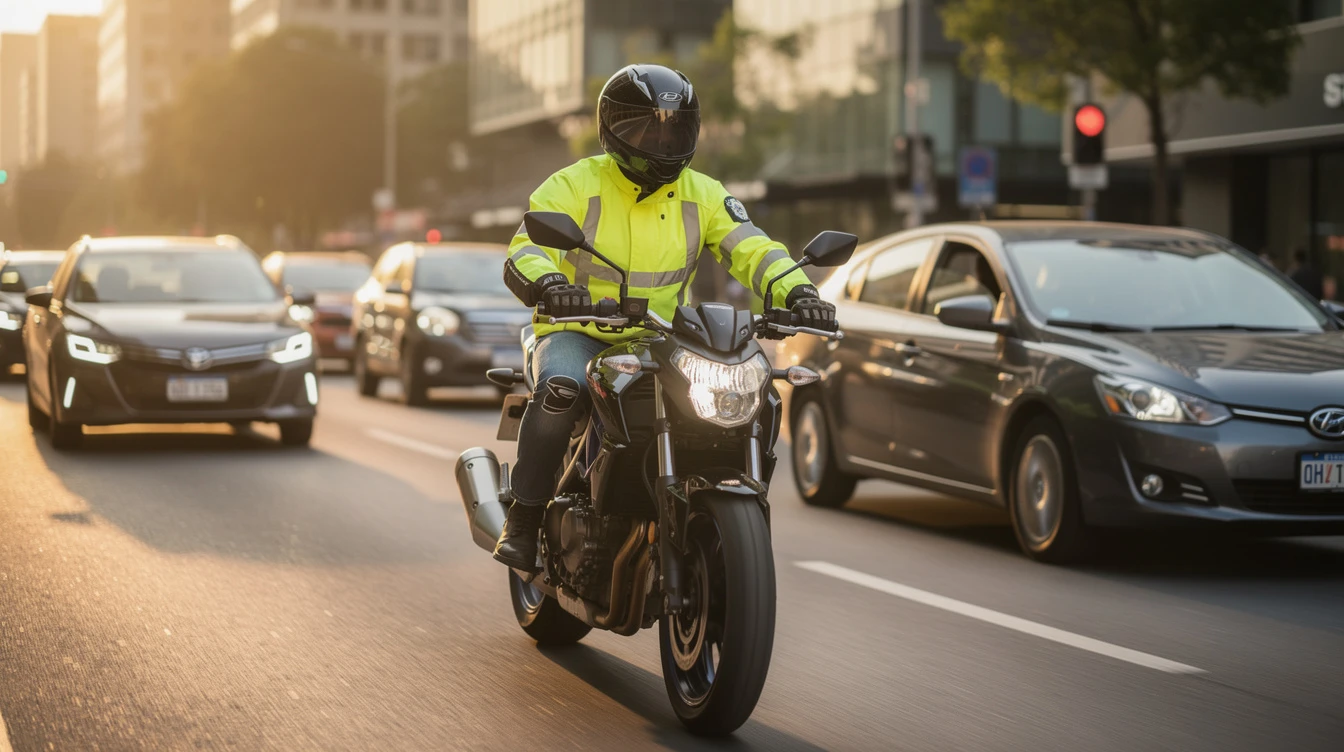

Improving your motorcycle safety when riding in traffic is one of the most important skills a rider can build, and it goes well beyond simply following the speed limit. Traffic is unpredictable. Cars change lanes without signaling, doors swing open without warning, and road conditions shift from block to block. This guide covers the practical strategies, mindset habits, and formal training steps that actually reduce your risk out there.
You'll find specific techniques for lane positioning, situational awareness, gear selection, and emergency response, plus answers to the questions riders ask most. Whether you're newly licensed or have years of miles behind you, there's something here worth applying on your next ride.
Riders who treat safety as an ongoing practice, not a one-time checklist, consistently fare better in traffic. Let's look at what that actually means in practice.
Why Motorcycle Safety in Traffic Demands a Different Mindset
A motorcycle occupies roughly 2.5 feet of width on the road, compared to a typical car at 6 feet. That size difference is a physical advantage in some situations, but it also means you're far easier to miss. According to NHTSA data, motorcyclists are about 28 times more likely per mile traveled to die in a crash than passenger car occupants. That number puts the stakes in plain terms.
Traffic riding requires what instructors call proactive scanning, which is a technique where you actively search the road environment ahead, behind, and to your sides in a continuous rotating pattern, rather than simply reacting to events as they happen. Reactive riding, where you wait for a hazard before responding, cuts your available decision time significantly, especially at speeds above 30 mph.
Skill vs. Road Strategy: Which Matters More?
Honestly, this is one of the most debated questions in rider education. motorcycle safety, both skill and road strategy matter deeply, but they serve different purposes. Skill handles what you do with the bike when things go wrong. Road strategy determines whether you put yourself in situations where things go wrong in the first place.
Experienced riders almost universally say strategy comes first. If your lane positioning, following distance, and hazard scanning are solid, you rarely need emergency braking or panic swerves. Strong bike-handling skills are your backup plan. They should not be your primary defense.
The complete motorcycle safety guide for every rider on this site goes deeper into how skill and strategy build on each other over time.
The "What If" Habit Every Traffic Rider Needs
One mental tool that top-tier riders use is asking "what if?" about every vehicle and intersection ahead. What if that truck drifts left? What if the light turns yellow as you reach the box? What if the parked car's door opens? Spending even two seconds on these questions at low attention cost keeps your brain in an active, prepared state rather than a passive one.
This is exactly what the mental edge for riding a motorcycle post covers in detail, including drills you can run on everyday commutes.
Lane Positioning and Following Distance in Traffic
Your position within your lane is not fixed. It's a tool. Most riders learn that a lane has three zones: left third, center, and right third. Each position serves a different purpose depending on traffic around you.
Ready to register your vehicle?
Join thousands of vehicle owners who use Montana Motorcycle Safety Foundation to handle their registration quickly.
Get started today. →- Left third: Increases your visibility to oncoming traffic and improves your sightlines through left-hand curves. Use it when following a vehicle and you want to be seen by the driver ahead of that vehicle.
- Center: Keeps maximum space on both sides. Good for open highway sections with low side-entry risk.
- Right third: Useful for right turns, but avoid lingering here in urban areas where parked car doors and pedestrians enter from the curb.
Following distance is the gap, measured in time, between your front wheel and the rear of the vehicle ahead. The standard taught in the MSF Basic Rider Course is a minimum 2-second following distance in ideal conditions, extended to 4 seconds in rain, poor visibility, or heavy traffic. At 40 mph, 2 seconds equals approximately 117 feet. At 60 mph, it's around 176 feet. Many riders dramatically underestimate how much space that actually requires.
How to Manage Blind Spots Around Trucks and SUVs
Large vehicles, specifically semi-trucks, SUVs, and vans, have blind spot zones that can swallow a motorcycle entirely. A semi-truck's blind spots extend roughly 20 feet in front, 30 feet behind, and one full lane-width to the right. Spend as little time as possible in those zones. Pass promptly and move to a position where the driver can see you in their mirrors, because a general rule of thumb is: if you can see the driver's face in their mirror, they can see you.
For more detail on safe following distances from both directions, the proper following distance behind a motorcyclist post is worth reading, especially if you share the road with other riders.
Intersections: The Highest-Risk Zone in Traffic
Intersections account for a disproportionate share of motorcycle crashes. The classic scenario is a left-turning vehicle that fails to yield to an oncoming motorcycle. Studies suggest this single maneuver, often called a SMIDSY (Sorry Mate, I Didn't See You), contributes to roughly 42% of car-versus-motorcycle collisions in the United States.
Approaching any intersection, reduce speed slightly, cover your brakes with 2-4 fingers resting on the lever, and scan for vehicles that haven't committed to stopping. Don't trust a stopped car to stay stopped.
Gear That Actually Improves Your Odds in Traffic
Gear is not just about crash protection. The right gear improves your situational awareness and reduces fatigue, both of which directly affect how well you ride in traffic.
A full-face helmet, which is a helmet that covers the entire head including the chin, provides the broadest protection and also reduces wind noise at highway speeds, cutting the cognitive load of riding. Studies by the Motorcycle Safety Foundation estimate that helmets reduce the risk of death by approximately 37% and brain injury by about 69%. That's not a marginal difference.
High-Visibility Gear and Why It Works
Bright colors and retroreflective materials make you visible to drivers who are not actively looking for you. Research from New Zealand's MAIDS study found that conspicuity aids, which include high-visibility vests, reflective tape, and bright helmet colors, reduced crash risk in low-light conditions by up to 37%. In traffic, you want every possible edge on visibility.
Look for gear with CE Level 1 or Level 2 armor ratings, especially for shoulders, elbows, and knees. Level 2 armor is tested to absorb impacts at a higher force threshold (less than 20kN transmitted to the body versus Level 1's 35kN limit), meaning it absorbs more energy before it reaches you.
Fatigue and Gear: The Connection Riders Often Miss
Windblast, noise, and vibration all cause fatigue faster than most riders expect. At 70 mph, wind pressure on an unhelmeted or open-face-helmeted rider is roughly equivalent to holding your hand flat out a car window, for hours. That physical stress depletes focus. Quality gear, including properly fitted jackets and gloves that reduce vibration transfer, helps you stay sharp for the full duration of a ride.
The post on the harsh reality of ignoring gear and pre-ride inspections covers this connection between physical fatigue and crash risk in detail.
| Safety Area | Recommended Standard | Why It Matters |
|---|---|---|
| Following Distance | 2 seconds minimum (4 seconds in rain) | Gives adequate braking and reaction time |
| Lane Position | Left or center third in most urban situations | Improves visibility to drivers and your own sightlines |
| Helmet Type | Full-face, DOT/ECE certified | Reduces death risk by ~37%, brain injury by ~69% |
| Intersection Approach Speed | Reduce and cover brakes 100+ feet out | SMIDSY crashes account for ~42% of car-vs-moto collisions |
| Scanning Pattern | Proactive 12-second ahead scan, continuous side checks | Allows earlier hazard detection and more response time |
| Gear Visibility | High-vis or retroreflective elements | Reduces crash risk in low-light by up to 37% |
| Formal Training | MSF Basic Rider Course + periodic refreshers | Builds both skill and strategy in structured environment |
Formal Training: The Fastest Way to Build Real Traffic Skills
Reading about traffic strategies helps. Riding through them in a controlled setting sticks much longer. The Motorcycle Safety Foundation Basic Rider Course is a structured training program that typically runs over a single weekend, combining about 5 hours of classroom instruction with 10 hours of on-bike exercises. It's built specifically to address the skill and judgment gaps that lead to crashes in real traffic.
Most states, including Montana, waive the DMV riding test for riders who complete an MSF-approved course, which is an added practical benefit on top of the skills gained.
What the MSF Course Teaches That You Won't Learn Solo
Self-taught riders often develop habits that feel comfortable but are tactically poor, including looking down at the front wheel during slow maneuvers (which causes wobble), fixating on hazards instead of escape routes (which causes target fixation, a dangerous phenomenon where riders steer toward what they're looking at), and braking too hard on the front in a straight line while forgetting rear input.
The course breaks those habits systematically. Instructors are trained to spot and correct them in real time, something no YouTube video or riding buddy can replicate. If you want to find a course near you, the motorcycle safety course near me guide walks through how to locate a DPS-approved or DMV-approved option in your area.
Advanced and Refresher Courses for Experienced Riders
The Basic Rider Course is the entry point, not the ceiling. Advanced courses, sometimes called the MSF Advanced Rider Course or ERC (Experienced Rider Course), cover higher-speed braking, emergency swerving, and hazard avoidance at speeds closer to real-world traffic conditions. Riders who've been on the road for 5 or 10 years often benefit most from these refreshers because bad habits have had time to solidify.
Much like how 56.2% of document issues in vehicle registration orders are resolved by a dedicated quality control team before they ever reach the customer, the value of expert review applies equally to riding skills, catching and correcting problems before they become dangerous on the road (internal data, rolling last 90 days, n=137).
The complete MSF course guide on this site covers both the Basic and advanced options, including what to expect on day one.
Emergency Skills That Could Save Your Life in Traffic
Even with perfect positioning and scanning habits, emergencies happen. A car cuts across your path. Gravel appears mid-corner. A dog runs into the lane. How you respond in the first 1.5 seconds determines the outcome.
Maximum Braking: Why Most Riders Leave Stopping Power on the Table
Modern motorcycles with combined or linked braking systems can stop from 60 mph in approximately 130-150 feet under ideal conditions. Most untrained riders, under panic conditions, stop in 200 feet or more because they under-apply the front brake out of fear of lowsiding. The front brake provides roughly 70-80% of a motorcycle's total stopping power. Not using it fully in an emergency is a significant disadvantage.
Practicing threshold braking, which is the technique of applying maximum braking force just short of wheel lockup, in a safe empty lot builds the muscle memory to do it correctly when it matters.
Swerving and Target Fixation
Target fixation is a well-documented phenomenon in rider training, defined as the tendency for a rider to steer toward whatever they focus on, even a hazard they're trying to avoid. It's responsible for a measurable percentage of single-vehicle crashes. The fix is deliberate practice: look at your escape route, not the obstacle. Trained riders learn to shift their gaze quickly and let the bike follow their eyes.
The emergency preparedness drills post covers specific exercises you can practice to build this skill without needing a formal course.
Frequently Asked Questions About Motorcycle Safety in Traffic
How much following distance should I keep in traffic?
The standard minimum is 2 seconds in good conditions, measured by picking a fixed point and counting after the vehicle ahead passes it. In rain, heavy traffic, or low visibility, increase that to at least 4 seconds. At 60 mph, 2 seconds equals about 176 feet, which sounds like a lot until you actually measure it on the road. Most riders keep far less than they think.
Does wearing a helmet actually make a significant difference in a crash?
Yes. Helmets reduce motorcycle fatality risk by approximately 37% and reduce brain injury risk by approximately 69%, according to research from the National Highway Traffic Safety Administration. A DOT or ECE-certified full-face helmet offers the broadest coverage. Open-face and half helmets provide less protection at the chin and jaw, which are common impact points in forward falls.
What is the MSF Basic Rider Course and who should take it?
The MSF Basic Rider Course, offered through the Motorcycle Safety Foundation, is a structured beginner training program combining classroom and on-range riding instruction, typically spread over a weekend (about 15 hours total). It's aimed at new riders but also benefits returning riders who haven't ridden in years. Many states waive the DMV skills test for graduates. It's one of the most efficient ways to build safe riding habits from the start.
Is lane splitting safe in traffic?
Lane splitting, which is the practice of riding between lanes of slow or stopped traffic, is currently street-legal only in California among U.S. states. In states where it's not permitted, it's a moving violation. Research from UC Berkeley found that lane-splitting riders were less likely to suffer head and torso injuries than non-splitting riders in rear-end crashes, but the risk profile changes significantly at higher speed differentials. The guide to lane splitting and filtering practices covers the full legal and safety picture.
How often should experienced riders take a refresher course?
Most rider safety experts recommend a formal refresher every 3-5 years for experienced riders, or after any significant gap in riding (6 months or longer). Skills degrade without regular practice, and road conditions and traffic patterns change over time. Many riders who took their initial course 10+ years ago find that an advanced or experienced rider course updates both their technique and their risk awareness significantly.
What are the most common mistakes riders make in traffic?
The most frequent issues include following too closely (under 2 seconds), riding in blind spots of larger vehicles, failing to cover the brake at intersections, choosing poor lane positions that reduce visibility, and not wearing high-visibility gear. Common mistakes are covered in detail in the 10 common mistakes to avoid when riding a motorcycle post, which also addresses the habit fixes for each one.
Does good gear really improve safety beyond crash protection?
Yes. Beyond protecting you in a crash, quality gear reduces fatigue, which is a direct contributor to poor decision-making in traffic. Wind noise at highway speeds causes cognitive fatigue faster than most riders realize. Properly fitted gear with adequate insulation for weather conditions helps you stay alert through longer rides. A rider who is tired and uncomfortable at mile 80 makes worse decisions than one who is physically at ease.
Where can I find a motorcycle safety course near me?
The quickest approach is to search for a motorcycle safety course near you using the MSF's provider directory at msf-usa.org. Courses are available in most states, including Montana and South Dakota. Some states offer subsidized or free options. A DPS-approved course is often eligible for insurance discounts, which can offset the typical $200-$350 course fee within a single policy period.
Riding in traffic safely is a skill set you build deliberately, not something that comes automatically with time on the road. The riders who consistently come home are the ones who treat lane positioning as a decision, not a default, who scan ahead instead of reacting to what's already happening, and who commit to formal training that exposes and fixes the gaps they didn't know they had. Whether you're preparing for your first course or looking to sharpen skills you've had for years, improving your motorcycle safety when riding in traffic is a process worth investing in, every single season.