You just bought a motorcycle, and the excitement is real. But before you roll out of the driveway, there are safety tips you need to know that most new riders find out the hard way. This guide covers gear, pre-ride habits, defensive riding techniques, and the training resources that can genuinely protect your life on the road.
New riders face a steep learning curve. The bike responds differently from a car, traffic treats you differently, and the margin for error is much smaller. The good news: most risks are manageable when you know what to do from day one.
Work through this guide before your first solo ride. Bookmark it. Share it with a friend who just bought their first bike too.
The Right Motorcycle Safety Gear for Daily Riding and Beyond
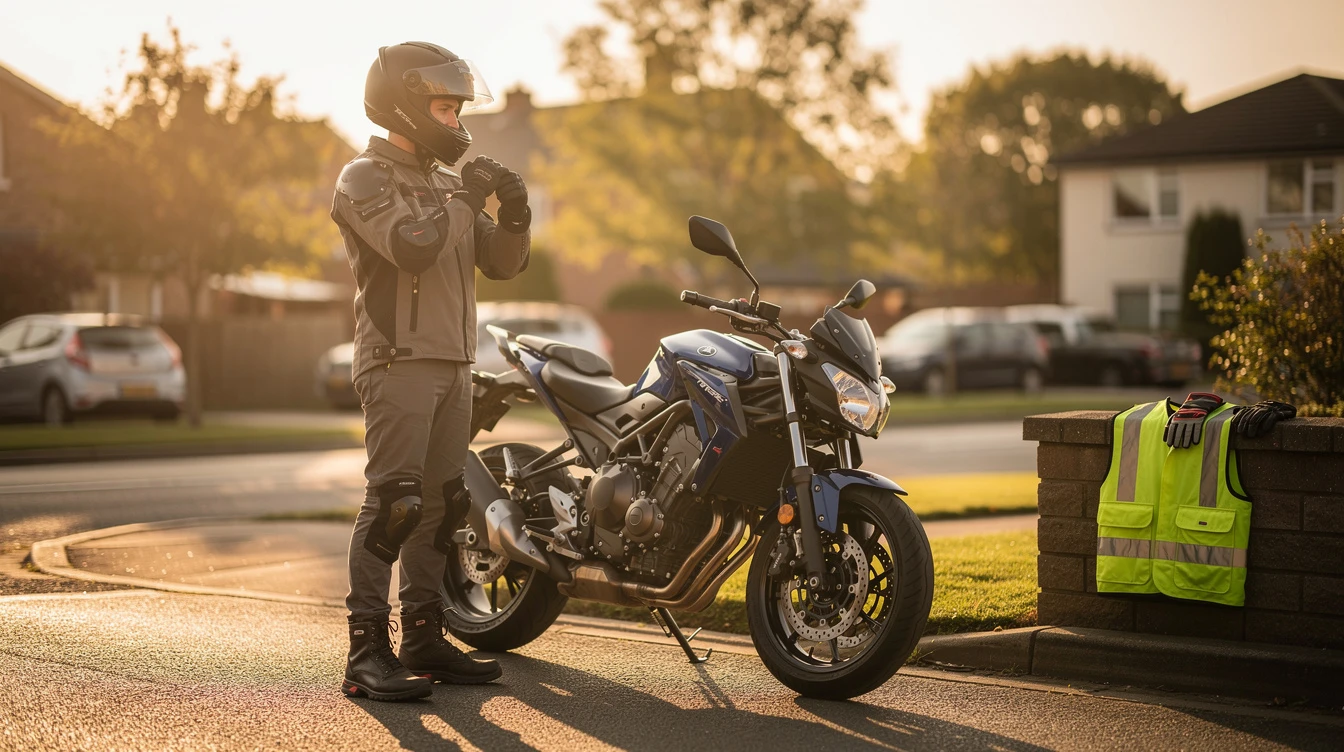
Gear is your first and most important line of defense. A motorcycle gives you zero structural protection in a crash, so your clothing and helmet do the work that airbags and crumple zones do in a car. Skipping proper gear because the weather is nice or the ride is short is one of the most common mistakes new riders make.
What motorcycle safety gear provides the best protection for daily commuting?
A full-face helmet rated DOT or ECE 22.06 is the single most important piece of gear you can own. Full-face designs protect your chin and jaw, which take significant impact in low-side crashes. Modular helmets are a compromise. Open-face helmets leave your lower face exposed. For daily commuting, full-face wins every time.
Beyond the helmet, you'll want:
- A riding jacket with CE-rated armor at the shoulders and elbows, and a back protector pocket
- Reinforced riding gloves, not standard work gloves
- Over-the-ankle boots with ankle reinforcement, not sneakers or sandals
- Riding pants with knee and hip armor, or separate CE-rated knee pads under regular pants
High-visibility gear dramatically improves how well other drivers see you, especially at intersections and during lane changes. Bright colors and reflective panels cost nothing extra at most gear retailers. See our full breakdown on why skipping gear and pre-ride inspections puts riders at serious risk for more context on what the data actually shows.
How to choose gear that fits and protects properly
Armor only works when it sits over the right body part. Try gear on in-store if possible. A jacket should fit snugly without restricting arm movement. Helmet padding should make full contact around your cheeks and crown with no pressure points. Too loose means it can rotate or come off in a crash. Too tight means pain and distraction on longer rides.
Honest advice: buy the best helmet you can afford, then fill in the rest of your gear from there. Skimping on a helmet to save $50 is not a trade worth making.
Pre-Ride Inspection: What to Check Before Every Single Ride
A motorcycle is a mechanical system. Things wear out, bolts loosen, tires lose pressure. Taking three minutes before every ride to run through a basic inspection can prevent mechanical failures that cause crashes. Experienced riders do this automatically. New riders often skip it because nothing has gone wrong yet.
Ready to register your vehicle?
Join thousands of vehicle owners who use Montana Motorcycle Safety Foundation to handle their registration quickly.
Get started today. →The T-CLOCS inspection method
The Motorcycle Safety Foundation uses the T-CLOCS framework as a pre-ride checklist. It stands for Tires and wheels, Controls, Lights and electrics, Oil and fluids, Chassis, and Stands. Working through each category takes less time than you think once it becomes habit.
- Tires: Check pressure with a gauge, look for cracks, bulges, or embedded debris
- Controls: Test both brakes for firm feel, check clutch and throttle for smooth operation
- Lights: Verify headlight, taillight, and both turn signals work
- Oil and fluids: Engine oil, brake fluid, and coolant levels should all be within range
- Chassis: Look for loose fasteners, chain tension and lubrication, any visible damage
- Stands: Make sure the kickstand and center stand (if equipped) retract fully
Why tire pressure matters more on a motorcycle than a car
A car has four contact patches, each roughly the size of your palm. A motorcycle has two, each about the size of a credit card. Underinflated tires on a motorcycle change how the bike steers, brakes, and corners, often in ways you don't notice until something goes wrong. Check pressure cold, before you ride, using your bike's owner manual spec, not the number printed on the tire sidewall.
Defensive Riding Techniques That Actually Keep You Alive
Most motorcycle crashes don't happen because a rider didn't know how to ride. They happen because of a driver who didn't see the bike, a road hazard that appeared without warning, or a split-second decision that went wrong. Defensive riding is about anticipating those moments before they become emergencies.
What are the top defensive driving techniques for motorcycle safety?
Positioning is everything. Ride in the part of your lane that gives you the most visibility and keeps you out of other drivers' blind spots. On a two-lane road, the left third of your lane lets you see oncoming traffic and makes you more visible to drivers turning across your path. At intersections, covering your front brake lever with two fingers buys you a fraction of a second of stopping distance when something darts out.
The four-second following distance rule applies to motorcycles too, but you should extend it to five or six seconds in poor visibility or wet conditions. That space gives you time to stop, swerve, or change your line when something unexpected happens. For a full breakdown on following distance, read what the proper following distance behind a motorcyclist actually means.
How to handle intersections as a new rider
Intersections are where most motorcycle-car collisions happen. A driver turning left across your path is the single most common crash scenario for riders. Approach intersections with one finger covering the front brake, scan for turning vehicles early, and be ready to reduce speed even if you have the right of way. Your survival doesn't depend on who was legally correct. It depends on what you do in the next two seconds.
Scan parked cars for wheels turned outward, doors opening, or exhaust smoke that indicates someone is about to pull out. This kind of constant, forward-looking awareness is what experienced riders call "reading the road." It's a habit, and it starts on your very first ride.
Cornering basics that prevent low-side crashes
Most new riders take corners too fast and then brake mid-corner, which is exactly what causes a low-side slide. The correct sequence is slow-look-press-roll: slow before the corner, look through it to your exit point, press the handlebar in the direction of the turn (counter-steering), then smoothly roll on the throttle through the exit. Braking mid-corner unloads the tires right when they need grip most. Our post on mastering motorcycle turns at low and high speeds goes much deeper on this skill.
| Safety Area | What to Do | Why It Matters |
|---|---|---|
| Helmet | Full-face, DOT or ECE rated | Protects chin/jaw in most crash scenarios |
| Jacket and Pants | CE-rated armor at shoulders, elbows, knees, hips | Reduces abrasion and impact injuries |
| Pre-Ride Check | T-CLOCS method every ride | Catches mechanical issues before they become crashes |
| Following Distance | Minimum 4-6 seconds | Reaction time for unexpected stops or hazards |
| Intersection Awareness | Cover brake, scan early, expect left turns | Left-turning cars are the top crash scenario |
| Cornering | Slow before, not during; counter-steer; roll throttle | Prevents low-side slides from mid-corner braking |
| Formal Training | Complete an MSF Basic Rider Course | Builds muscle memory, improves survival skills |
Formal Training: Why the MSF Basic Rider Course Changes Everything
Reading about riding is not the same as training for it. A formal course gives you a controlled environment to build muscle memory, correct bad habits early, and make your first mistakes without traffic around you. Skipping formal training because you already know how to ride a bicycle, or because a friend taught you the basics, is how many preventable crashes happen in the first year of riding.
What is usually covered in a motorcycle safety course?
The MSF Basic Rider Course is the industry standard for new riders across the country. It includes an eCourse component you complete before class, followed by range time where you practice low-speed maneuvering, braking, cornering, and emergency stops on a real motorcycle. Instructors watch your technique and give immediate feedback. You won't learn that from YouTube.
Topics covered in a typical course include:
- Motorcycle controls and startup procedures
- Low-speed balance and throttle control
- Braking technique, including maximum braking practice
- Cornering and swerving
- Riding strategies for intersections and traffic
- Protective gear selection and use
Many states waive the DMV riding test if you pass the MSF course. In Montana, completing an approved course fulfills the skills test requirement for your motorcycle endorsement. Read more about how to get a motorcycle license in Montana and what the endorsement process looks like.
I just passed the motorcycle safety course. What now?
Passing the course is the start, not the finish line. Your first 1,000 miles of solo riding are statistically the most dangerous, because you're applying new skills in real traffic for the first time. Ride in low-risk conditions at first: daylight, dry roads, lower-speed routes. Avoid highways and heavy traffic until basic handling feels instinctive. Consider taking an advanced MSF course six to twelve months after you start riding, once you have real-world mileage to build on.
For riders in Montana specifically, finding a motorcycle safety course near you is easier than most new riders expect. Courses run throughout the riding season and many county programs offer subsidized or reduced-cost options.
Road Hazards New Riders Often Miss
Car drivers notice potholes and road debris as minor inconveniences. For a motorcycle, the same hazard can cause a crash. New riders are often surprised by how much of riding is about reading the road surface, not just the traffic around them.
Surface hazards that catch new riders off guard
Gravel on pavement, especially at corners and on-ramps, causes tires to lose traction suddenly. Sand deposited by winter road treatment stays on road shoulders and intersections long after temperatures rise. Railroad tracks and expansion joints crossing at an angle to your path should be taken as close to 90 degrees as possible. Wet paint, metal grates, and manhole covers become extremely slippery in rain.
The approach: scan ahead at least four seconds, identify hazards early, and adjust your line before you reach them. Reacting at the last second usually makes things worse. Our post on 10 common mistakes to avoid when riding a motorcycle covers several of these surface hazards in detail.
Weather and visibility conditions to watch
Rain reduces tire grip and makes road surfaces unpredictable. Riding through rain is manageable if your gear is waterproof and you reduce speed and following distance. The most dangerous moment in rain is the first ten minutes of a shower, when fresh water mixes with road oil before washing it away. Wind is a significant factor on motorcycles because your body acts as a large sail. Side gusts on open roads or when passing large trucks require constant handlebar correction.
Cold weather introduces its own hazards, including ice, reduced tire grip when cold, and cognitive slowing from temperature exposure. Our guide on cold weather riding, layering, and staying alert on icy roads is worth reading before the season changes.
Frequently Asked Questions from New Motorcycle Riders
Do I need to take a motorcycle safety course if I already know how to ride?
Yes, and here's why. Most people who say they already know how to ride have learned from friends or informal practice, which means they've also picked up incorrect habits they don't know about. Formal training through the Motorcycle Safety Foundation Basic Rider Course corrects those habits before they become crash risks. Even experienced riders who take refresher courses regularly report measurable improvements in braking distance and cornering technique.
What is the most dangerous situation for a new motorcycle rider?
Intersections. Specifically, vehicles turning left across your path when you're traveling straight. This is the most common crash scenario for motorcyclists and is responsible for a significant share of rider fatalities each year. The counter-strategy is to slow approaching intersections, cover your front brake, and scan for any vehicles that might be preparing to turn. Assume they don't see you until they've made eye contact and acknowledged you.
How long does it take to become a confident motorcycle rider?
Most riders report feeling genuinely comfortable in traffic after roughly 1,000 to 2,000 miles of riding. That's not a guarantee of skill, just a range where basic control stops requiring conscious thought. Building real skill takes longer. Regular riding, formal training, and deliberate practice in challenging but controlled conditions all accelerate the process. Read our full breakdown on how long it really takes to become a skilled motorcyclist.
Can I ride with a passenger right after getting my license?
Technically yes in most states, but practically, it's not a good idea until you have at least several months of solo riding experience. A passenger adds significant weight, changes the bike's handling characteristics, and requires clear communication between both riders. Your braking distance increases, cornering feels different, and low-speed balance requires more active correction. Our guide on riding with a passenger and two-up safety covers what you need to know before taking anyone along.
Is lane splitting safe for new riders?
Lane splitting and filtering laws vary by state, and the skill required is not beginner-level. It demands precise low-speed control, high situational awareness, and the ability to read driver behavior accurately. New riders should wait until they have solid foundational skills before attempting it, even in states where it's permitted. For a full look at the laws and techniques involved, read our post on lane splitting, filtering, and riding practices.
What should I do immediately after my first ride?
Honestly, debrief yourself. What felt uncertain? Where did you brake later than you wanted to? Were there moments where you weren't sure what gear you were in? Those are your training priorities. New riders improve fastest when they identify specific weak points and work on them deliberately, rather than just accumulating miles. Consider keeping a short notes log after each ride in your first few months. Small friction points compound into big skill gaps if you ignore them early.
Does the MSF Basic Rider Course replace the DMV riding test?
In many states, yes. Montana recognizes the MSF course completion as fulfilling the riding skills test requirement for a motorcycle endorsement. You'll still need to pass the written knowledge test at the DMV, but passing the MSF range portion typically waives the separate riding exam. Check with your state's motor vehicle division for current requirements, as policies can change. The DPS approved motorcycle safety course page covers state-specific details for riders in applicable areas.
Your Next Step as a New Rider
Getting a motorcycle is the beginning of something genuinely rewarding. The riders who stay safe long-term share a few things in common: they wear proper gear every ride without exception, they build their skills through formal training, they stay alert to the road surface and the traffic around them, and they keep learning. That last part matters. The complete motorcycle safety guide for every rider is a great next read once you've worked through this one.
The Montana Motorcycle Safety Foundation exists to give riders at every level access to the training, resources, and community they need to ride well and ride long. Whether you're preparing for your first solo ride or building skills after your first season, the resources here are built for you.
Get started today and ride with confidence from day one.